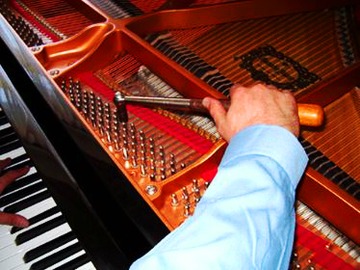
Pianos in Malaysia go out of tune faster than pianos almost anywhere else, and it is not the playing that does it. Humidity moves the soundboard, the soundboard moves the strings, and the tuning goes with them. We tune instruments we sold and instruments we have never seen before, and we will tell you which of the three jobs below yours needs.
Booking the wrong one is the usual reason a tuning does not hold. Find the sentence below that sounds like your piano and tell us which it is.
The piano is close to A440 and gets seen once or twice a year. This is a straight tuning, done in one visit, and the instrument holds it because it never travelled far from pitch in the first place.
Nobody has touched it for several years and the whole instrument has sagged below pitch. This needs a pitch raise, then a tuning after it settles. Two visits, and the second one is the one that lasts.
Single notes beating against themselves, or one note that has gone sour while the rest sound fine. That is usually a unison or a loose tuning pin rather than the whole piano, and it is closer to a repair than a tuning.
Concert pitch is only the starting reference. What you actually hear is whether each note agrees with its own strings and with the octave above it, and that is the part that takes the time.
A tuner who only tunes hears one thing. A tuner who spends the rest of the week rebuilding actions hears what is going to fail next, and tells you before it does.
The one question that changes everything is how long it has been. Answer that honestly and the visit gets planned correctly the first time.
Make, roughly when it was last tuned, and which area you are in. That is enough to plan it.
If it has drifted a long way below A440 we will tell you it is two visits before you book, not after we arrive.
Tuning is done at your piano. There is no reason to move an instrument to have it tuned.
A440 set, unisons cleaned, and anything starting to go wrong flagged while it is still cheap to fix.
Tuning is done in your own home, so the only thing that matters is whether we can get to you. These are the areas the technicians cover routinely.
Our piano shop is at Tropicana City Mall in Petaling Jaya, so most of Kuala Lumpur and Selangor is inside an hour of a van. We do travel further for the right job, and delivery on a piano bought from us is free anywhere in Peninsular Malaysia. Staircase carries are quoted separately, because the cost comes from the steps and the turns rather than the distance.
The soundboard moves with the humidity and the strings go with it. Where you stand the piano matters more than how often you book us.
Two to four men, proper skids and straps, and the route walked before the piano comes off the wall. Stairs, lifts, narrow landings and grands taken down in parts.
Sticking keys, dead notes, broken hammer shanks, worn centre pins and pedals that no longer bite. Most of it is action work, and most of it is fixable.
Full rebuilds. Strings, dampers, hammers and action through to case refinishing. The same work we do on our own stock before it reaches the floor.
Rent a restored Japanese upright by the month, take one for a few weeks around an exam, or have a piano delivered and collected for a single event. Delivered, positioned and tuned by our own crew.
Every Yamaha and Kawai we sell has been through the workshop twice before it reaches the floor. Free delivery, a bench, two tunings and a five-year warranty are in the price.
Almost always, but not in one visit. An instrument that has dropped a long way below A440 needs a pitch raise first, which is a rough pass that gets the whole harp back up under tension, then a proper tuning once it has settled. Trying to do it in one go leaves the piano drifting again within days.
Tightening every string on a piano puts roughly a tonne of extra pull on the frame, and the strings you tuned first go flat again as you work through the rest. A pitch raise absorbs that movement deliberately so the tuning afterwards holds.
Play the same note an octave apart, then play a simple chord you know well. A piano that is evenly flat sounds dull rather than wrong, which is why people living with it often stop noticing. A piano that is out with itself sounds sour, and that one is obvious.
We can tune it, but say so when you book, because it will drift faster than one on an inside wall. In Malaysian humidity the wall a piano lives against matters more than most people expect, and moving it two metres often does more for the tuning than tuning it again does.
Yes, and that is why two tunings after delivery are included in the price of everything we sell. The instrument needs a couple of weeks to settle to the humidity of its new room before a tuning will hold properly.
Tell us the make, roughly when it was last tuned and where you are. If it has been years rather than months, say so, because that changes what the first visit is.