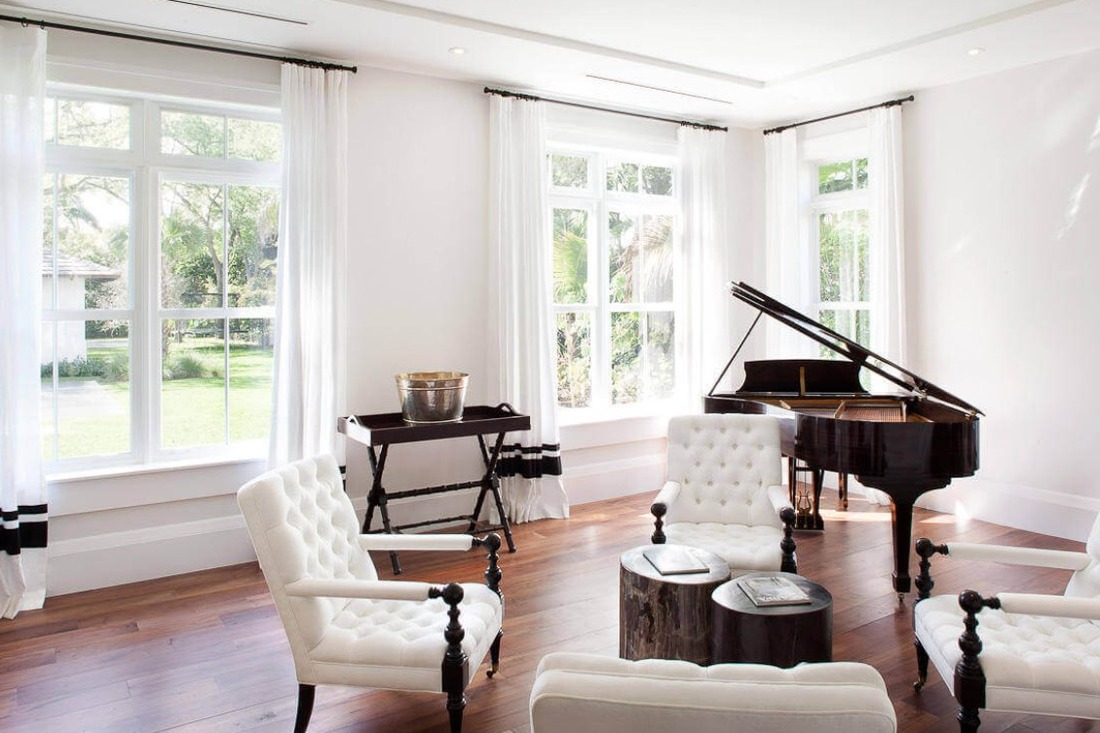
Kawai grands come through in smaller numbers than Yamaha, so this page does not pretend to be a catalogue. Tell us the room and the budget and we will tell you what we have or what we can source for you.
We do not keep a standing list of grands online, and any dealer who does is usually showing you a piano that sold months ago. Grands arrive in ones and twos, they are prepared to order, and the right instrument depends as much on your room as on the model badge.
So the honest process is short: tell us the room and the budget, and we will tell you what we have or what we can source. If nothing suitable is on the floor, we will say so rather than push you toward the wrong piano.
This is where most grand enquiries end, so it is worth settling early. Measure the space the piano will live in, then tell us the number.
Length from the keyboard to the tail, and the width at the widest point. Then add walking room on every side.
Door widths, lift depth, landing turns and whether the management office will release the service lift on the day.
A grand sounds very different with the lid up. In a small hard room, a fully open lid can be too much.
If the room is tight, a tall Kawai upright gives you much of the bass without the floor area. We will say so if that is the better call.
The model name alone tells you very little. Each page below gives the length, the weight and the case dimensions of that model, plus an honest read on whether it suits your room. We do not hold all of these at once, so use them to work out what you want, then ask us what is on the floor.
Kawai's long-running grand line. The number tracks length: a KG-1 is 164 cm, a KG-8 is a 276 cm concert instrument.
The line that replaced the KG series, with a redesigned action and a stiffer rim.
Studio and conservatory grands built for institutions, which is where most of them spent their working life.
Kawai's earlier grand numbering. Many are two-pedal instruments from the domestic Japanese market.
Acoustic pianos fitted with Kawai's silent system, so the action can be muted and played through headphones.
Kawai's hand-built flagship line, made in small numbers and voiced individually. Rare on the used market anywhere.
Not a consolation prize. A full-height Kawai upright at 131 cm beats a tired small grand on tone, on tuning stability and on what it costs to keep.
Including instruments we did not sell. Grands are moved in parts by our own crew, not by a general removal team.
Talk to us about it. Kawai grands come through in smaller numbers than Yamaha, so rather than list stock that may already be gone, we would rather hear your room size and budget and tell you what is actually available.
The soundboard for cracks, the pin block for tuning stability, the hammers for wear, and how evenly the action repeats. We check all of it in the workshop before anything is offered, and we will walk you through what was replaced.
No, the schedule is the same: twice a year in this climate. What a grand does need is more careful placement, away from direct sun and air-conditioning flow, because a large soundboard reacts to both.
Then we say so. A tall Kawai upright such as the K48 gives you a lot of the low end without the floor area, and it is a far easier instrument to live with in a Malaysian apartment.
Grand stock moves quickly. Message us with your room size and budget and we will tell you what is available, or whether an upright is the better buy.