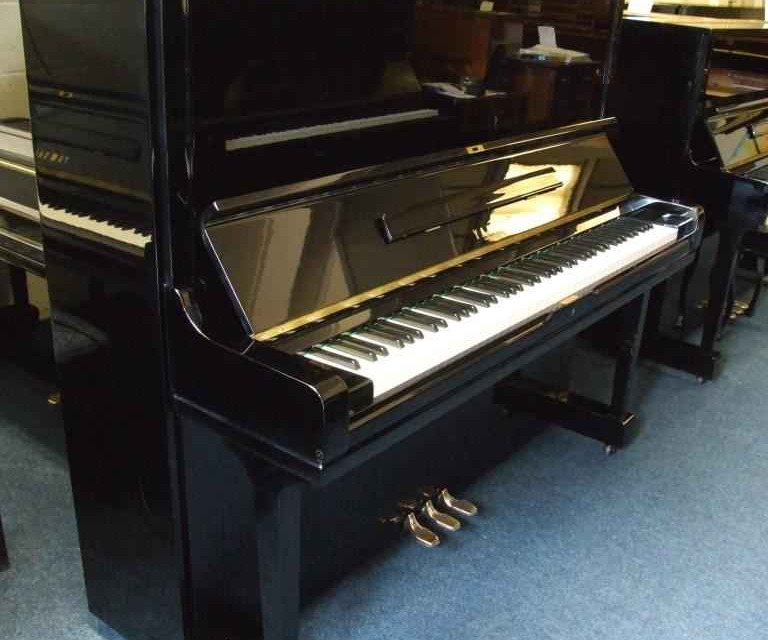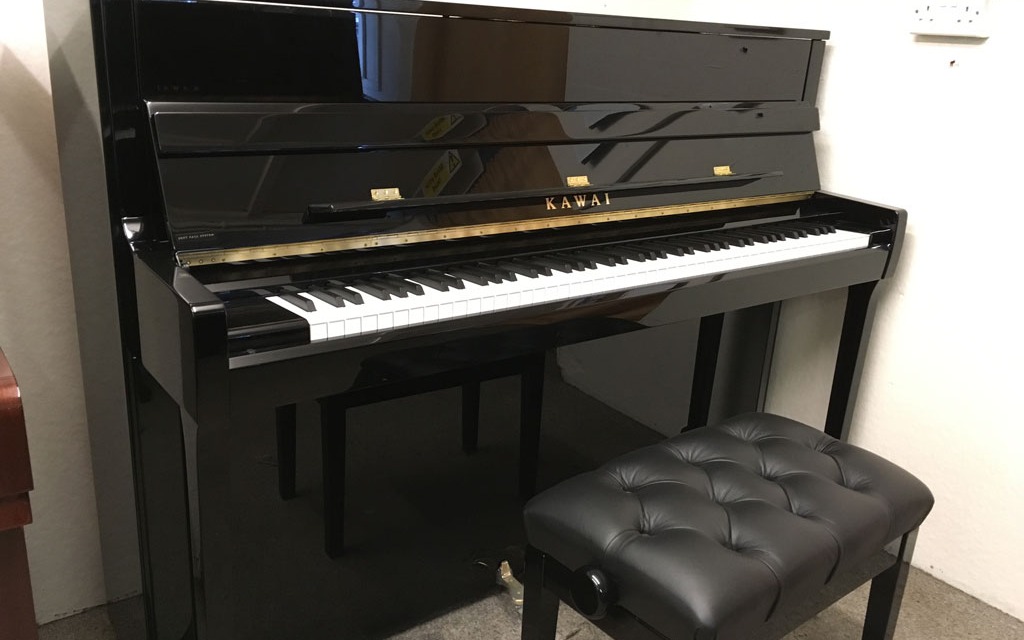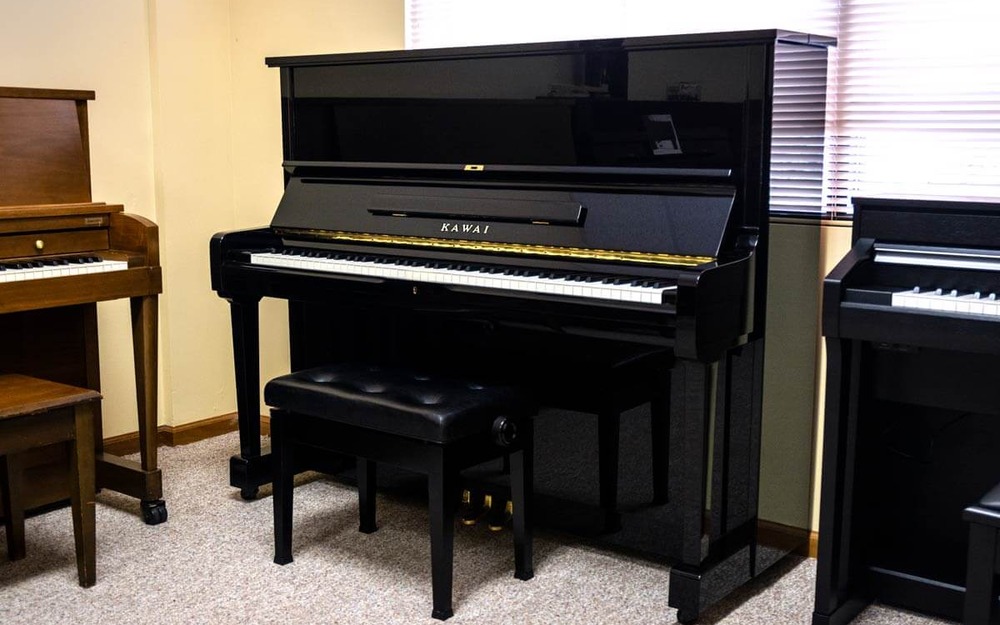
- The number on the badge is the case height, not the footprint. Every upright is roughly 150 cm wide and 60 cm deep whatever the height says.
- Height buys bass, not treble. The difference between a 121 cm and a 131 cm instrument is obvious in the left hand and marginal at the top.
- Height drags weight with it, and weight is what decides a staircase. A 121 cm Yamaha U1H is 217 kg. A 132 cm Kawai US-65 is 270 kg.
- In a small hard-walled apartment, a shorter piano is often the more pleasant one to practise on for an hour.
The number on an upright, 121 or 127 or 132, is the height of the case from the floor to the top lid. It is not the width and it has nothing to do with how much floor the piano occupies. Almost every upright ever built is around 150 cm wide and 60 cm deep, so a 101 cm compact and a 132 cm professional case take up the same footprint in your room.
What the height actually measures is string length. A taller case lets the bass strings run longer and the soundboard grow larger, and those two things are most of what people hear when they say one piano sounds fuller than another. Every model page in our used piano catalogue leads with that number for the same reason.
The four upright piano heights you will meet on the used market
Sorting the used market by height rather than by brand makes it far easier to think about, because the four groups below behave differently in a room, on a staircase and under the hands.
- 101 to 113 cm, console. Yamaha's LU-101 at 101 cm and 198 kg, the M1A at 108 cm and 180 kg, Kawai's KST-2 at 115 cm. Built for small Japanese rooms. The lightest acoustic pianos you can buy and the easiest to get up a staircase.
- 114 to 124 cm, compact. The Kawai KU-1 and BL-11 sit here at 124 cm. A real step up in bass over a console without the weight of a full case.
- 125 to 129 cm, mid. The busiest part of the market. Yamaha's U1H at 121 cm sits just below it, the U2H at 127 cm and Kawai's BL-31 and BS-2A at 125 cm sit in it.
- 130 cm and up, full height. Yamaha U3H at 131 cm and 248 kg, Kawai K35 and K48 at 132 cm, and the Kawai US-65 at 132 cm and 270 kg. This is what music schools buy.
| Model | Height | Weight | Class |
|---|---|---|---|
| Yamaha LU-101 | 101 cm | 198 kg | Console |
| Kawai KU-1 | 124 cm | 205 kg | Compact |
| Yamaha U1H | 121 cm | 217 kg | Mid |
| Kawai BL-31 | 125 cm | 200 kg | Mid |
| Yamaha U2H | 127 cm | 228 kg | Mid |
| Yamaha U3H | 131 cm | 248 kg | Full height |
| Kawai US-65 | 132 cm | 270 kg | Full height |
What the extra centimetres buy you
The honest answer is bass, and mostly bass below the stave. Play a U1H and a U3H back to back in the same room and the difference in the top two octaves is small. Play a left hand octave low down and it is obvious immediately. The taller piano has somewhere for that note to go.
There is a second effect nobody mentions in showrooms. A taller piano is louder, and a loud piano in a small tiled apartment with hard walls can be genuinely unpleasant to practise on for an hour. More than one family has moved from a 131 cm instrument down to a 121 cm one and been happier.
Nobody has ever come back to us because their piano was too quiet. Several have come back because it was too loud for the room they put it in.
Where upright piano height turns into a real problem
Moving day. A 121 cm Yamaha U1H weighs 217 kg. A 132 cm Kawai US-65 weighs 270 kg. That is 53 kg of difference, which sounds manageable until it has to go up a staircase with a turn on the half landing and there is no service lift. Our piano movers ask for photographs of that turn before quoting anything, because it decides the job far more than the distance does.
Free delivery covers a ground floor or a unit reachable by service lift. A staircase carry is quoted separately, and that quote scales with the weight, so the height you choose has a real cost attached if the piano is going upstairs.
How to actually decide on a height
Work backwards from the constraint rather than forwards from the wish. If the piano is going to a ground floor or there is a service lift, ignore the weight entirely and pick on sound. If it is going up stairs, get the weight number first and let that set the shortlist, because there is no point falling in love with a US-65 that cannot get there.
Then measure the wall. Not the width, which will be fine, but whether there is 30 cm of clearance for the bench and enough room to sit without your back against furniture. That is what makes a piano pleasant to practise at, and it has nothing to do with the height on the badge.
If the household has not settled on whether the lessons will stick, height is a decision you can defer. Renting a piano puts a real instrument in the room for a few months, and under our rent-to-own arrangement the rent you have paid comes off the price if you keep it. Terms and conditions apply.
Which brand at which height
Once the height band is settled, the choice narrows to two names, and that is a different question with a different answer. We have written it up separately in our comparison of used Yamaha and Kawai uprights, or you can browse the full lists by brand: Yamaha uprights and Kawai uprights.
Every height and weight quoted here is the manufacturer figure for that model, and it is the same figure printed on the model page linked beside it. We keep the specifications because we have to know them before a crew is sent out. Nothing on this page is an estimate.